Quick Facts
- Angle Range: 15 to 30 degrees adjustable in 1/4 degree increments.
- Build Quality: Heavy-duty metal chassis construction weighing 7.5 lbs for maximum stability.
- Abrasive Selection: Comprehensive set including diamond plates, ceramic, and leather.
- Blade Capacity: Securely holds any knife up to 5/32 inch spine thickness.
- Maintenance Type: Mess-free manual fixed-angle dry sharpening system requiring no oils or water.
- Specialized Support: Includes a small knife table and ceramic rod for serrated edges.
To sharpen hunting knives with the Work Sharp Professional Precision Adjust, secure the blade in the metal chassis clamp and use the digital angle indicator to set a bevel between 15 and 30 degrees. Consistency is maintained by pulling the magnetic abrasive rod over the edge at a fixed angle. For premium steels like S30V, ensure the blade is held perfectly horizontal to maintain a uniform bevel across the entire length of the cutting edge.
Achieve a master-class edge on your hunting tools using the Work Sharp Professional Precision Adjust. This guide covers angle settings, sharpening grit progression, and the Sharpie method. Whether you are prepping for a backcountry elk hunt or maintaining your everyday carry, understanding how to use this manual fixed-angle system is the key to professional-grade results.
Understanding Blade Geometry and Angle Selection
When it comes to hunting knife edge maintenance, the most critical factor is the relationship between the steel hardness and the angle of the bevel. Hunting knives are often subjected to rigorous tasks like field dressing, skinning, and jointing, which demand a balance between hair-popping sharpness and edge durability. Most outdoor knives perform best when sharpened to a specific range that prevents the edge from chipping or rolling under pressure.
The Work Sharp Professional Precision Adjust system allows users to set sharpening angles between 15 and 30 degrees, which encompasses the 17 to 25 degree range typically recommended for maintaining the durability and sharpness of hunting knives. For a dedicated slicer used mainly for fine skinning, you might lean toward the 17 to 18-degree mark. However, for a general-purpose camp knife or a folding hunter, a 20 to 25-degree angle provides a sturdier edge that can handle accidental contact with bone.
Blade geometry also plays a role in how the abrasive interacts with the steel. A thicker blade spine requires more attention to how it sits within the clamp to ensure that the bevel remains consistent from the heel to the tip. Setting the correct angle is not just about sharpness; it is about respecting the original design of the tool while optimizing it for your specific hunting tasks.
Setup: Using the Digital Angle Indicator and Sharpie Method
The hallmark of the Work Sharp Professional Precision Adjust is its rigidity and precision. Unlike plastic versions, the metal chassis construction of this tool eliminates any flex during the sharpening stroke. Before you begin, the setup is paramount. You must first secure the knife in the V-Block Clamp. If your hunting knife has a thick spine, up to 5/32 inch, make sure the clamp is tightened sufficiently so the blade cannot wiggle.
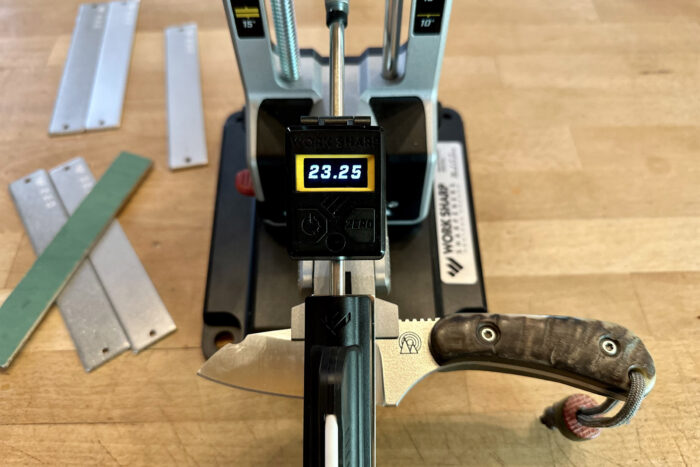
Once clamped, it is time to use the digital angle indicator for precision sharpening. This small tool sits on the sharpening rod to give you a real-time readout of your exact angle. However, the biggest secret among professional sharpeners is the Sharpie Method. Simply take a black permanent marker and color the entire factory bevel of your knife.
- Set your estimated angle on the Work Sharp Professional Precision Adjust.
- Lightly swipe the abrasive across the colored edge.
- Inspect the mark: if the ink is removed at the very top of the bevel, your angle is too steep; if it is removed only at the bottom (near the shoulder), your angle is too shallow.
- Adjust in 1/4 degree increments until the abrasive removes the ink evenly across the entire bevel.
This ensures you are hitting the factory bevel exactly, which saves time and preserves the life of your blade. It is the most reliable way to maintain consistent blade geometry without removing unnecessary amounts of expensive steel.
The Professional Sharpening Grit Progression
Success in sharpening is dictated by how well you follow a logical sharpening grit progression. For a very dull or damaged knife, you must begin with a coarse diamond plate, typically between 220 and 400 grit. This stage is where you perform the heavy lifting, also known as reprofiling. You are essentially grinding away enough metal to form a new apex on the edge.
As you work the coarse grit, you are looking for burr formation. A burr is a microscopic wire edge that folds over to the opposite side of the blade once you have reached the apex. Once you feel that burr along the entire length of the knife, you switch sides and repeat.
| Stage | Grit / Tool | Purpose |
|---|---|---|
| Repair / Reprofile | 220 - 320 Diamond | Removes chips and sets the initial angle |
| Refinement | 600 - 800 Diamond | Smoothes the scratch pattern from the coarse work |
| Polishing | Fine Ceramic | Works on the honing process by removing the burr |
| Final Stropping | Leather Strop | Polishes the steel to a mirror edge finish |
After the initial reprofiling dull hunting knives with Work Sharp diamond plates, you progress to the 600 and 800 grit plates. These refine the edge, making it smoother and more refined. The final steps involve the ceramic rod and the leather strop. The honing process with ceramic removes the last remnants of the burr, while the leather strop, often loaded with a fine abrasive compound, delivers that coveted mirror edge finish.
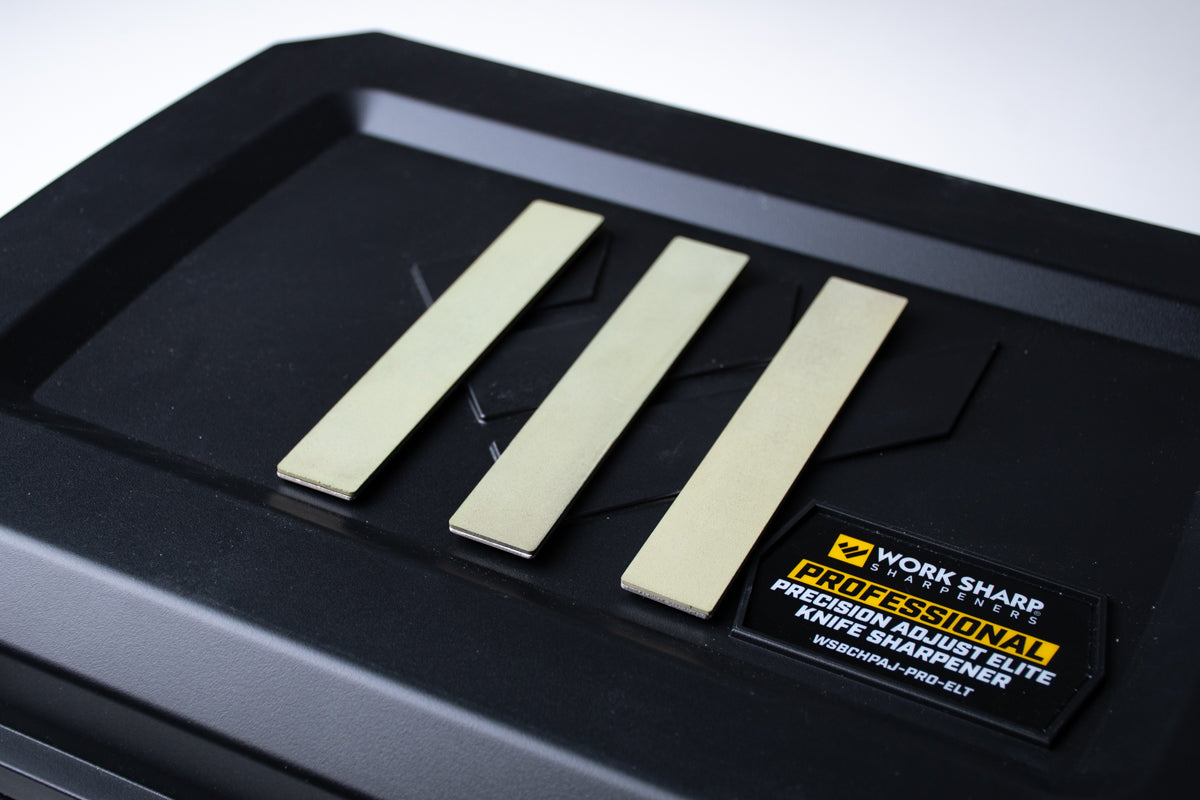
When maintaining razor sharp edge on S30V hunting knives, or other "super-steels" like M390 or CPM-20CV, the use of resin bonded diamonds is highly beneficial. These steels are incredibly hard, and traditional stones can take hours to make progress. The diamond abrasives in the Tri-Brasive system cut through these hard carbides efficiently, ensuring you don't spend all day at the workbench.
Specialized Edges: Serrations and Folding Knives
Not every hunting knife is a standard drop-point fixed blade. Many hunters carry a folding knife for light-duty tasks or a knife with serrations for cutting through heavy rope or cartilage. The Work Sharp Professional Precision Adjust is designed to handle these specialized edge types with ease.
For small folding knives, the system includes a small knife table accessory. This is a game-changer for blades as short as one inch. Instead of using the standard clamp which might be too wide for tiny blades, the magnetic table stabilizes the knife, allowing the abrasive rod to move freely without hitting the clamp. This ensures you can maintain the same level of precision angle control on your pocket folder as you do on your primary skinning knife.
If your hunting knife has a serrated section, do not ignore it. Using Work Sharp Professional Precision Adjust for serrated edges involves using the specialized ceramic rod attached to the abrasive handle. Rather than grinding across the serrations with a flat plate, you use the round ceramic rod to hone each individual scallop. This restores the "bite" that serrated knives are known for.
For those moments when you are miles away from your workshop, the Work Sharp Guided Field Sharpener serves as an excellent companion. It features 20-degree and 25-degree angle guides specifically built to restore a hair-popping edge in the field, ensuring your tools never fail you during a pack-out.
FAQ
What is the difference between Work Sharp Precision Adjust and Professional?
The standard Precision Adjust is a consumer-grade tool primarily made of high-quality polymers, whereas the Work Sharp Professional Precision Adjust features a heavy-duty metal chassis construction. The Professional version also includes a digital angle indicator for precision sharpening, a small knife table for compact blades, and a wider range of abrasives including a leather strop and specialized ceramic rods. The Professional model weighs significantly more (7.5 lbs), providing a much more stable and rigid base for sharpening super-steels.
How do you use the Work Sharp Professional Precision Adjust knife sharpener?
To use the sharpener, you first clamp your knife securely in the V-Block Clamp, ensuring the spine is flush and centered. You then set your desired sharpening angle using the digital angle indicator. Select your starting abrasive—usually a coarse diamond plate if the knife is dull—and move the rod in a consistent sweeping motion from the heel of the blade to the tip. Once a burr forms along the entire edge, flip the clamp and repeat on the other side. You then progress through finer diamond grits, ceramic, and leather to finish the edge.
Can you sharpen serrated knives with the Work Sharp Professional?
Yes, you can sharpen serrated knives with the Work Sharp Professional Precision Adjust. The system includes a specialized ceramic rod that is designed to fit into the individual scallops of a serrated blade. Unlike flat diamond plates that would grind down the points of the serrations, the round ceramic rod allows you to hone the inner curves of each serration individually, restoring their original cutting geometry and sharpness.
Does the Work Sharp Professional Precision Adjust come with a case?
The Work Sharp Professional Precision Adjust does not come with a traditional soft-sided carry case like the smaller Elite model; instead, it is designed as a stationary workshop tool. However, it is built with a rugged, integrated design that keeps all components organized. The stability provided by its metal base makes it a permanent fixture for many enthusiasts' workbenches, though it can be disassembled if long-term storage or transport is required.